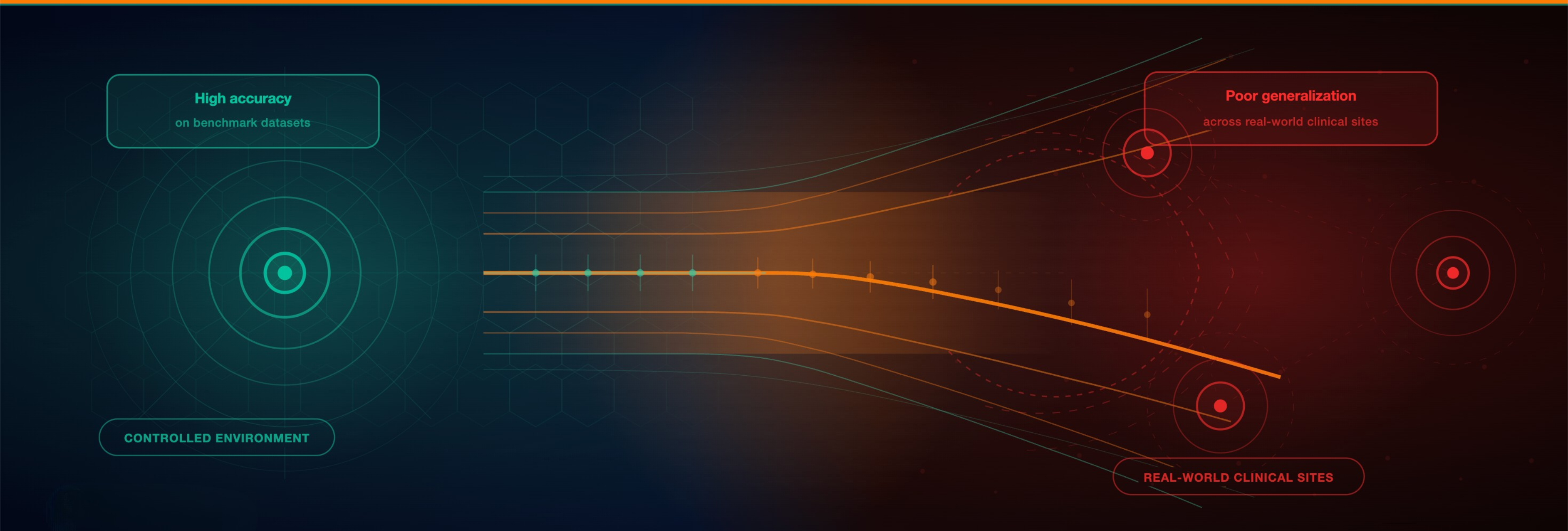
At the Health.Tech Global Summit in Basel, leaders from healthcare, AI, pharma, and policy came together to discuss the future of AI-driven healthcare innovation. Across keynotes, panels, and side events, one central theme emerged:
The future of healthcare AI depends on high-quality, globally representative data.
A Shift in Focus: From Models to Data Foundations
For years, innovation in medical AI has focused on improving algorithms—making them faster, more scalable, and more powerful. At this year’s summit, the conversation is evolving.
Industry leaders emphasized the need to rethink the foundations of AI:
- AI performance is limited by data quality and representation
- Scaling AI requires clean, structured, and harmonized datasets
- Innovation must move beyond models to data infrastructure
As highlighted during the summit:
“Data is everything. But you need high-quality data. It has to be global.”
This shift reflects a broader realization: better models alone are not enough if the underlying data is incomplete or biased.
Superlab Suisse Panel: Addressing the Data Gap in Healthcare AI
At the Superlab Suisse side event, moderated by Jubin Shah, PhD, key stakeholders discussed systemic challenges in healthcare data.
During the panel, our CEO & Co-Founder Dr. Manasi A-Ratnaparkhe emphasized:
“Data gaps existed long before AI. AI just made them visible.”
The discussion highlighted several critical issues:
- Many medical datasets lack global representation
- Data diversity is not only genetic but also technical (e.g., scanners, workflows)
- Existing systems (EHR, radiology, labs) remain fragmented and unharmonized
This underscores a key challenge in AI-driven healthcare:
If patients are not represented in the data, they are not represented in outcomes.
Data Harmonization as a Key Enabler
Across multiple sessions, including discussions at Roche, data harmonization emerged as a critical enabler of scalable AI.
Key takeaways included:
- Collecting data is not sufficient; data must be harmonized and standardized
- Insights must be integrated and actionable, not fragmented
- Scaling AI requires scaling high-quality data, not flawed datasets
In practice, this means shifting from:
- Data collection → Data usability
- Isolated datasets → Interoperable ecosystems
- Generic models → Patient-specific insights
Trust, Bias, and Responsible AI
Beyond technical challenges, the summit also addressed trust and responsibility in AI.
From healthcare to legal systems, speakers emphasized:
- AI must actively address bias and underrepresentation
- Trust in AI is built through data quality and transparency
- Ethical deployment is essential for real-world impact
As highlighted during the panel:
“Trust is not a feeling; it is a strategic operational asset.”
From Insight to Action: Building the Right Data Infrastructure
The discussions at the summit strongly align with the work we are advancing.
Our focus is on building globally diverse, clinically validated, and technically harmonized datasets that enable:
- Representation across underrepresented populations
- Integration of multimodal and real-world data
- Development of trustworthy, scalable AI solutions
Because AI in healthcare must work for every patient, not just the represented few.
Looking Ahead: How Far Can We Go?
The summit marked a clear transition in how AI in healthcare is understood and discussed.
The key question is no longer whether data matters but:
How far can we go in building truly inclusive, data-driven healthcare systems?
Request access to PAICON’s global oncology data infrastructure